
Here’s a number that might surprise you: according to the CDC, the average American teen reaches their peak height by age 16 for girls and 18 for boys — but most of them never fully maximize what their body was actually capable of.
That gap between potential height and actual height is real. And a big part of what determines which side of that gap you land on isn’t your genetics. It’s what you do — or don’t do — during those critical years between 12 and 18.
Exercise isn’t a magic trick. Nobody’s going to grow five inches overnight from doing jumping jacks. But the right kinds of movement, done consistently during adolescence, genuinely do support height development. They stimulate growth hormone, decompress the spine, and keep posture aligned so you’re actually standing as tall as your skeleton allows.
This guide breaks down the most effective height growth exercises for teens — with real science behind them, a ready-to-use daily routine, and honest expectations about what’s possible at different ages.
Why Exercise Still Works After Age 12
A lot of teens — and parents — assume that once puberty starts, the window for influencing height is basically closed. That’s not quite accurate.
Here’s what’s actually happening inside a growing body:
- Growth plates are still open: These are soft cartilage zones near the ends of long bones — the femur, tibia, spine — where new bone tissue forms. In most teens, these plates don’t fully close until 16–18 for girls and 18–21 for boys. While they’re open, the body is still actively adding length to the skeleton.
- The spine has more room than you think: The vertebral column accounts for roughly 35% of total standing height. Between each vertebra sits a disc of cartilage that compresses throughout the day under gravity. Targeted stretching and decompression exercises can restore that lost space — and over time, improve actual spinal length.
- Exercise triggers growth hormone release: A 2018 review published in Sports Medicine confirmed that high-intensity and resistance exercise significantly elevates growth hormone (GH) levels in adolescents. GH doesn’t just build muscle — it directly stimulates bone growth at the growth plates.
- Bottom line: if you’re between 12 and 18, the door isn’t closed. But it is closing. Which means now is the time to move.
The 7 Most Effective Height-Boosting Exercises
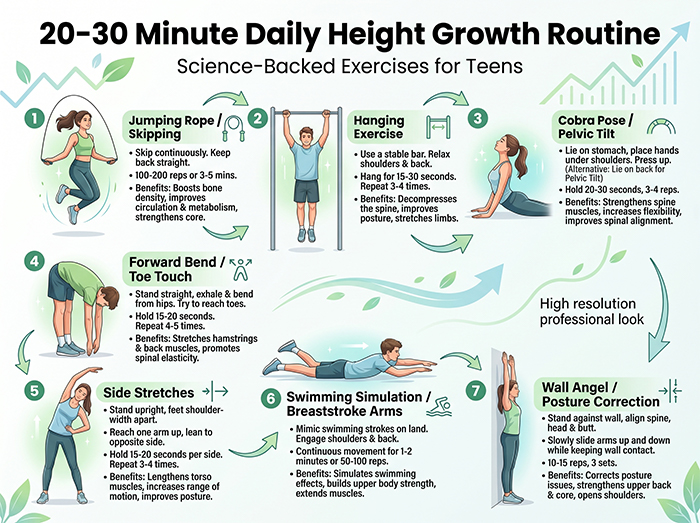
7 Best Daily Exercises to Increase Height for Teens in 2026 – Complete 20-30 Minute Science-Backed Routine.
1. Hanging (Dead Hang)
How to do it: Grip an overhead bar with both hands, shoulder-width apart. Let your body hang completely loose — no bent knees, no tension in the shoulders. Hold for 20–30 seconds.
Reps: 3–5 sets daily
Why it works: Gravity compresses the spine all day. Hanging actively reverses that compression, creating space between vertebrae and stretching the cartilage discs. Over consistent practice, this contributes to measurable improvements in standing height.
2. Cobra Stretch
How to do it: Lie face down, palms flat on the floor under your shoulders. Slowly press up, arching your back and lifting your chest. Hold for 15–20 seconds, then lower.
Reps: 3 sets, hold 15–20 seconds each
Why it works: Directly targets the thoracic and lumbar spine. Strengthens the muscles that support upright posture, which is one of the most underrated factors in how tall you actually appear — and over time, how tall you actually become.
3. Cat-Cow Stretch
How to do it: Start on all fours. Inhale and drop your belly toward the floor, lifting your head and tailbone (cow). Exhale and round your spine toward the ceiling, tucking chin and pelvis (cat). Move slowly and controlled.
Reps: 10–15 full cycles
Why it works: Mobilizes every segment of the spine and increases flexibility in the intervertebral discs. Think of it as hydrating the cartilage between your vertebrae.
4. Jump Rope
How to do it: Standard jump rope, two feet together or alternating. Keep a steady, moderate pace.
Duration: 5–10 minutes
Why it works: Jumping exercises for height growth work by creating brief, repeated impact forces through the legs and spine — a stimulus that research associates with increased bone density and growth plate activity. It also spikes growth hormone more effectively than most people realize.
5. Swimming (or Dry Land Swimming)
How to do it: If pool access isn’t available, lie face down and alternate lifting opposite arm and leg off the ground, as if swimming freestyle.
Duration: 10–15 minutes (pool) or 3 sets of 30 seconds (dry land)
Why it works: Full-body extension with zero spinal compression. Swimming is consistently cited in pediatric sports medicine literature as one of the best activities for adolescent skeletal development because it lengthens the body without the joint stress of impact sports.
6. Pelvic Tilt
How to do it: Lie on your back, knees bent, feet flat. Flatten your lower back against the floor by tightening your core and tilting your pelvis slightly upward. Hold 5 seconds, release.
Reps: 3 sets of 10
Why it works: Corrects anterior pelvic tilt — one of the most common postural problems in teens who sit for hours — which can cause the lumbar spine to compress and visually shorten the torso.
7. Forward Spine Stretch
How to do it: Sit on the floor with legs straight out in front. Reach both arms forward as far as possible, trying to touch your toes. Hold the furthest point for 15–20 seconds.
Reps: 3–5 holds
Why it works: Stretches the entire posterior chain — hamstrings, lower back, thoracic spine. Tight hamstrings pull the pelvis down and compress the lumbar spine. Loosening them directly improves standing posture and spinal decompression.
Complete 20–30 Minute Daily Height Growth Routine
| Time | Exercise | Duration / Reps |
|---|---|---|
| 0:00–2:00 | Light warm-up (arm circles, neck rolls) | 2 min |
| 2:00–7:00 | Jump rope | 5 min |
| 7:00–12:00 | Dead hang | 5 × 30 sec holds |
| 12:00–16:00 | Cobra stretch + Cat-cow | 3 sets each |
| 16:00–20:00 | Forward spine stretch | 4 × 20 sec holds |
| 20:00–23:00 | Pelvic tilt | 3 × 10 reps |
| 23:00–28:00 | Dry land swimming | 3 × 30 sec |
| 28:00–30:00 | Cool down, deep breathing | 2 min |
Best time to do this routine: Morning after waking up (spine is least compressed) or evening before bed. Avoid right after a heavy meal.
Common Mistakes Teens Make When Trying to Grow Taller
Doing it for a week, then quitting. Height development is slow. The teens who see results are the ones who show up for months, not days.
Skipping the basics and only doing stretches. Flexibility work matters, but without the compound movements that trigger growth hormone — like jumping and hanging — you’re leaving a lot on the table.
Terrible posture the other 23 hours of the day. Thirty minutes of spine stretching doesn’t undo eight hours of hunching over a phone. Posture awareness has to be an all-day habit.
Overtraining. More is not always better. Growth happens during recovery, not during the workout itself. Two to three rest days per week is appropriate.
Ignoring pain signals. Sharp pain in joints or growth plate areas (just above and below the knee, for example) is a signal to stop, not push through.
How to Maximize Results: Sleep, Nutrition, and Posture
Exercise is the engine. But it needs the right fuel and conditions to run.
Sleep: Up to 80% of daily growth hormone is secreted during slow-wave (deep) sleep, according to the National Sleep Foundation. Teens need 8–10 hours. Cutting that to 6 hours doesn’t just make you tired — it directly reduces the hormonal environment that makes growth possible.
Nutrition: The Growth Trio — Calcium, Vitamin D3, and Vitamin K2 — supports bone mineralization and growth plate health at a structural level. Dairy, leafy greens, fatty fish, and eggs cover a lot of this ground. For teens with inconsistent diets, many families supplement strategically. Brands like NuBest offer targeted growth support formulas that some parents incorporate alongside a healthy routine during these peak development years.
Posture: Stand against a wall with your heels, glutes, upper back, and the back of your head all touching. That’s what neutral alignment feels like. Practice holding it for 60 seconds daily. Gradually it becomes your default.
These three factors — sleep, nutrition, posture — don’t replace exercise. They multiply it.
Expected Results: Realistic Timeline
| Age Group | Growth Plate Status | What Exercise Can Do |
|---|---|---|
| 12–14 | Fully open | Significant support for active growth phase; best window for compound impact exercises |
| 15–16 | Partially open | Still meaningful; focus on spinal decompression and GH stimulation |
| 17–18 | Closing or closed | Limited skeletal growth possible; posture correction can add 1–2 inches in appearance |
Honest expectations: Teens in the 12–15 range who follow a consistent routine, sleep well, and eat adequately can genuinely support 0.5–2 additional inches of height compared to doing nothing. That’s not a guarantee — genetics still set the ceiling. But the ceiling is higher than most people realize, and consistent habits determine how close you get to it.
For 16–18 year olds, the primary gain shifts from skeletal growth to postural correction and spinal health — which still matters both for appearance and long-term back health.
In conclusion,
There’s no shortcut here. But there is a real, science-backed path — and it’s simpler than most teens expect.
Show up for the 25-minute routine. Guard your sleep. Feed your bones what they need. And stand up straight.
Do those four things consistently from now until your growth plates close, and you will reach closer to your actual genetic potential than the average American teen does. That’s not a sales pitch. That’s just what the research supports.
The teens who look back at 25 and feel good about their height aren’t the ones who found some secret hack. They’re the ones who took the basics seriously when it counted.
REFERENCES
Frequently Asked Questions
Yes — particularly through growth hormone stimulation, spinal decompression, and maintaining optimal conditions for open growth plates. The effect is strongest between 12–15 but continues through 17–18 to a lesser degree.
Dead hangs are consistently ranked highly for spinal decompression. Combined with jump rope for GH stimulation, these two cover the most ground with the least time investment.
For most girls, growth plates close between 15–17. For most boys, between 17–20. These are averages — individual timing varies significantly based on genetics and the onset of puberty.
Swimming is excellent for full-body elongation without joint compression. It's particularly good for teens who are already active in high-impact sports and need a balance. It's one of the best, but not necessarily better than a complete routine that includes hanging and jumping.
Most teens notice postural improvements within 4–6 weeks. Measurable height gains from skeletal growth take 3–6 months of consistent effort.
Yes, with 1–2 rest days per week. The routine is low-impact enough to sustain daily, but rest allows the growth and recovery process to complete.
Running creates beneficial impact forces that stimulate bone growth, similar to jump rope. Long-distance running at high volume, however, can elevate cortisol levels, which may actually inhibit growth hormone. Moderate running is fine; training for marathons at 14 is not ideal.
It's not too late for posture correction, which can add 1–2 inches in visible height. And depending on where you are in your individual development, some skeletal growth may still be possible. The habits you build now also protect your spinal health for the next 60 years.

Hi everyone, I’m Tony Scotti, an expert in the field of height increase with many years of experience researching and applying height increase methods, and have achieved promising results. I have created increase height blog as a personal blog to share knowledge and experience about what I have learned during the process of improving my own height.