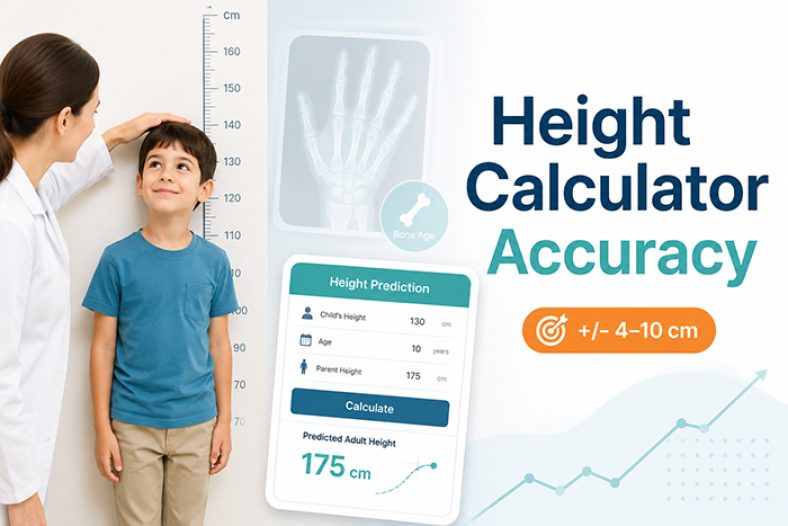
Search "how tall will my child be" and you'll find a dozen calculators, each spitting out a confident-sounding number. Almost none of them tell you how far off that number can realistically be. Here's every major method side by side, what the actual published research says about each one's error margin, and a quick tool to help you pick the right one for your situation.
Every Method, Side by Side
| Method | Typical Error | How It Works |
|---|---|---|
| "Double height at age 2" | Highly variable | An old folk rule with no real formula. Somewhat closer for boys, who grow for longer, but generally unreliable and not based on published prediction research. |
| Mid-parental height | ±8.5–10 cm | Averages both parents' heights with a fixed 13 cm sex adjustment. Only explains about a third of real height variation — see our full breakdown. |
| Khamis-Roche method | ±4.3–5.6 cm | Adds the child's own current height, weight, and age to mid-parental height. Validated for ages 4–17.5; developed in a Caucasian American sample. |
| Bayley-Pinneau (bone age) | ±4–6 cm | Reads skeletal maturity from a hand-and-wrist X-ray, then applies published tables. Widely used clinically, but can be off by several cm in atypical maturation. |
| Tanner-Whitehouse (TW2/TW3) | ±4–6 cm | A more detailed bone-age scoring system, examining multiple individual bones rather than the hand as a whole. Similar overall accuracy to Bayley-Pinneau. |
Why "More Accurate" Still Means Several Centimeters Off
Height is one of the most heritable human traits — genetics accounts for roughly 80% of the difference in height between people in a population. That sounds like it should make prediction easy. It doesn't, for two reasons that apply to every method on this list.
First, heritability describes patterns across large groups, not certainty for one child. Genes set a wide range of possible outcomes, and where a specific child lands within that range still depends on nutrition, illness, sleep, hormones, and the timing of puberty — all invisible to a formula that only sees height and weight numbers. Second, every method here was built from a specific historical population. When that population's growth patterns shift over time (taller each generation) or differ from a new child's background (ethnicity, nutrition era, geography), the formula's assumptions quietly stop matching reality.
The "gold standard" isn't gold-plated. Bone age is often described as the most accurate method, but a study comparing bone-age predictions to actual adult height in children with growth hormone deficiency found the Bayley-Pinneau method underestimated final height by 4.1 cm in girls and 6.1 cm in boys, on average — and TW2 was off by even more in the same children. Bone age is genuinely the most reliable option in typical, healthy growth, but "most reliable" is not the same as "precise," especially outside typical cases.
A Closer Look at Each Method
What This Means For You
The practical takeaway: Use whichever method matches the data you actually have, treat the result as a band of several centimeters rather than a single number, and let a real pediatrician — not a bigger, fancier calculator — settle anything that actually matters clinically.
Frequently Asked Questions
Which height prediction method should I trust the most?
Generally, more inputs mean better accuracy: bone age and Khamis-Roche both outperform mid-parental height alone. But "more accurate" still means several centimeters of real uncertainty, so none of them should be treated as a firm number.
Is it worth getting a bone-age X-ray just out of curiosity?
Not usually. Bone age involves a real (if small) radiation exposure and a clinician's time, and it's typically reserved for situations where a doctor suspects a genuine growth concern — not for satisfying curiosity about an otherwise healthy child.
Why do different calculators give me different numbers for the same child?
Because they're using different methods with different inputs and different error margins. A mid-parental estimate and a Khamis-Roche estimate for the same child can reasonably differ by several centimeters — that's expected, not a sign either one is broken.