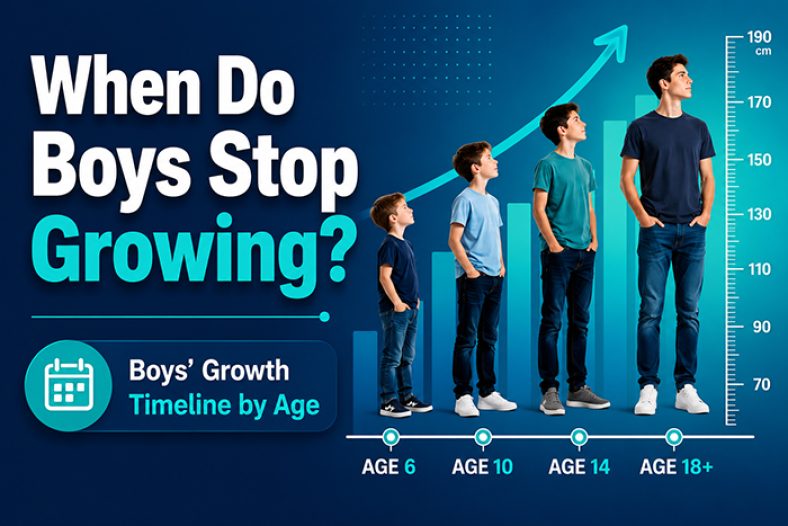
Short answer: Most boys stop growing taller between ages 16 and 18, once rising testosterone (and the estrogen it converts into) causes the growth plates in the long bones to fuse. But "stopping" isn't a single date — it's a gradual slowdown, and the exact timing depends heavily on when a boy starts puberty in the first place. The chart and calculator below show the general pattern; the sections after it walk through why the timing varies so much from boy to boy.
Key Takeaways
- Growth plates in boys typically fuse between ages 16 and 18, though full closure can extend into the early 20s for some.
- The trigger isn't age itself — it's sex hormone exposure. Rising testosterone (partly converted to estrogen) gradually hardens the growth plate cartilage until it can no longer lengthen.
- Genetics explain a large share of adult height differences between individuals, but the timing of puberty, nutrition, sleep, and overall health all influence when growth actually wraps up.
- A boy who starts puberty later than his peers ("constitutional delay") usually keeps growing longer and often reaches a normal adult height for his family — just on a later schedule.
- A bone age X-ray is a far more reliable way to estimate remaining growth than chronological age or current height alone.
Boys' Growth Timeline: When Does Height Stop?
The chart below tracks the average growth pattern for boys from birth to age 21. Tap each life stage to see what's happening — and use the quick check at the bottom to estimate where a boy is in his growth journey.
Is He Still Growing? Quick Estimate
Enter age and current height. The estimate updates automatically and compares height with an age-based average.
The Real Trigger: It's Hormones, Not a Birthday
It's tempting to think of "stops growing" as a date on a calendar, but biologically it's a chemical process. Long bones lengthen at the growth plates (epiphyseal plates) — thin bands of cartilage near each end of the bone where new cells are constantly produced. As long as a growth plate is "open," the bone can get longer.
Puberty changes that. Rising testosterone drives the growth spurt, but part of that testosterone is converted into estradiol (a form of estrogen) by an enzyme called aromatase. Research on male bone biology has shown that estrogen — not testosterone directly — is the hormone that ultimately signals the growth plate cartilage to stop multiplying and harden into solid bone, a process called ossification. Once a critical threshold of circulating estrogen is reached and sustained, the growth plate fuses permanently, and that bone cannot lengthen again.
This is also why boys, on average, keep growing about two years longer than girls: testosterone rises later and more gradually than the hormone surge that drives female puberty, so the estrogen threshold that closes the plates is reached later in boys.
What Determines *When* It Happens
Genetics
Twin and family studies consistently attribute the majority of adult height variation between men to inherited genes, though the exact figure varies by study and population. Genetics doesn't just set a height "ceiling" — it also influences the pace of puberty, which is part of why height often runs in families. See our guide on the role of genetics in determining height.
Puberty Timing
A boy who enters puberty at 10–11 will typically finish growing earlier than one who starts at 14–15. Later starters generally get a longer window of pre-pubertal, steady growth before the spurt — which is one reason "late bloomers" often catch up in height.
Nutrition & Sleep
Growth hormone is released mainly during deep sleep, and bone lengthening requires adequate protein, calcium, vitamin D, and overall calories. Chronic undernutrition or poor sleep won't change genetic potential, but it can prevent a child from reaching it. See how sleep affects height growth.
Health Conditions
Chronic illness, hormonal disorders (like growth hormone deficiency or hypothyroidism), and certain medications can either delay puberty and prolong growth, or in rarer cases accelerate bone maturation and close growth plates earlier than expected.
"Late Bloomer"? What Constitutional Delay Really Means
The most common reason a boy looks "behind" — and usually isn't
- Constitutional delay of growth and puberty is the most common cause of a boy appearing short or "behind" his peers in the young teen years, according to pediatric endocrinology references.
- These boys usually have a delayed bone age — their skeleton is biologically younger than their birth-certificate age — often confirmed with a simple hand and wrist X-ray.
- A family history of "late bloomers" (a parent who also grew and developed later than average) is common in these cases.
- Because their growth plates stay open longer, these boys typically continue growing into the later teen years and usually reach an adult height that fits their genetic/family pattern — just later than classmates.
- This is different from a growth *disorder*: once puberty begins, it tends to progress normally and the growth spurt follows.
If a boy is noticeably shorter than his peers in early-to-mid adolescence but is otherwise healthy, growing steadily, and has a family history of later development, that's a reassuring pattern rather than a red flag — though it's always worth mentioning to a pediatrician at a routine checkup.
Signs Growth May Be Slowing or Wrapping Up
- Shoe size has been stable for a year or more. Feet tend to stop growing before overall height does, so a long plateau there is a useful early clue.
- Voice has fully deepened and stayed stable for many months, a sign puberty is in its later stages.
- Facial and body hair growth has matured to an adult pattern.
- Height hasn't changed on the growth chart across 2+ checkups spaced 6–12 months apart — a single flat measurement isn't meaningful, but a sustained plateau is.
- He's 18 or older. By this point, most boys are at or very near their final adult height, since growth plates have largely fused.
How Doctors Actually Estimate Remaining Growth
Frequently Asked Questions
Most boys reach close to their final adult height by age 18, once their growth plates have fused. Some continue with small amounts of growth into their early 20s, especially if puberty started later than average.
It's possible but limited. If growth plates haven't fully fused — more common in boys who went through puberty later — a small amount of additional height gain can occur into the early 20s. For most, though, height is essentially set by 18. See Can You Grow Taller After 19? for a deeper look.
The most reliable clinical method is a bone age X-ray showing fused growth plates. Practical at-home clues include a stable shoe size for a year or more, a fully settled voice, and no measurable height change across two checkups 6–12 months apart.
Not usually. Boys with constitutional delay of growth and puberty ("late bloomers") tend to have a longer runway of growth before their spurt and typically reach an adult height consistent with their family pattern — just on a later timeline than peers.
Rising sex hormone levels during puberty — particularly estrogen, which is produced in boys partly by converting testosterone — gradually cause the cartilage in the growth plate to harden into solid bone. Once that process (ossification) completes, the bone can no longer lengthen.
No — it's typically only recommended when a doctor is investigating unusually short stature, very early or very delayed puberty, or a significant drop-off on the growth chart. For most healthy, steadily growing kids, routine height and weight checks are enough.
Continue Reading
Can You Grow Taller After 19?
What the research says about growth beyond the teen years.
The Role of Genetics in Determining Height
How much of adult height really comes down to DNA.
How Sleep Affects Height Growth
Why deep sleep matters for growth hormone release.
Human Growth Hormone (HGH) and Height
How HGH works and when it actually matters.
Height Growth Potential Quiz
A quick, interactive way to explore growth potential.
Child Height Prediction Calculator
Estimate a child's likely adult height range.
References
- Rochira V, Kara E, Carani C. The Endocrine Role of Estrogens on Human Male Skeleton. Int J Endocrinol. 2015;2015:165215. PMID: 25873947. doi:10.1155/2015/165215
- Constitutional Growth Delay. StatPearls [Internet]. National Library of Medicine, NCBI Bookshelf. NBK539780
- Constitutional Growth Delay — Patient Education. Pediatric Endocrine Society & American Academy of Pediatrics, Section on Endocrinology. pedsendo.org
- Silventoinen K, Sammalisto S, Perola M, et al. Heritability of adult body height: a comparative study of twin cohorts in eight countries. Twin Res. 2003. PMID: 14624724
- Centers for Disease Control and Prevention, National Center for Health Statistics. Clinical Growth Charts. cdc.gov/growthcharts
This article is for general educational purposes and is not a substitute for professional medical advice. If you have concerns about a child's growth or pubertal development, consult a pediatrician or pediatric endocrinologist.