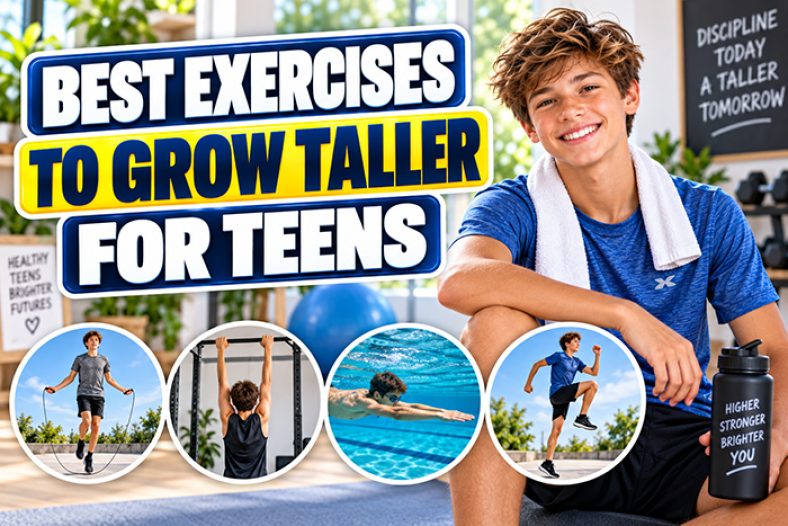
Growth Science
Exercise gets marketed as a height hack more often than the evidence actually supports. This guide separates what's genuinely well-documented — bone density, posture, and general health during the growing years — from claims about exercise adding inches of skeletal height that current research doesn't back up, then gives ten exercises with real video demonstrations so the routine is actually easy to follow correctly.
What Exercise Can and Can't Do for Height
Why the Growth Plate Window Still Matters
It's true that the years before growth plates close are the ones where a person's genetic height potential actually gets realized. Growth plates typically close somewhere around 13-16 years old in girls and 15-19 in boys, though the exact timing varies by bone and by individual. While they're open, adequate nutrition, sleep, and general health allow someone to grow toward their full genetic potential; poor nutrition or chronic sleep deprivation during this window can mean falling short of it. Exercise fits into this picture mainly by supporting overall health and bone strength during that window, not by independently adding height on top of it.
A 2018 review in the Journal de Pediatria covering physical activity and children's growth states plainly that there is no scientific basis for the idea that resistance training changes growth plate activity during puberty, and that popular beliefs linking specific sports to final height (for example, that basketball makes people taller or gymnastics stunts growth) are not supported by evidence. A separate systematic review and meta-analysis of resistance and endurance training in children and adolescents found only small, often statistically non-significant changes in growth hormone from structured exercise training over time, even though a single workout does produce a real short-term hormone spike.
The 10 Exercises in This Routine
None of the exercises below will add height beyond a person's genetic ceiling. What they do offer is real: better posture, spinal mobility, bone-loading stimulus, and the general physical groundwork that supports healthy development through the teen years. Each card includes a short video so the form is easy to check before trying it.
- Use a step or bench to reach an overhead bar without jumping into position.
- Grip the bar shoulder-width apart, palms facing away from you.
- Lift your feet off the step so your body hangs with straight arms, relaxed shoulders.
- Hold, breathing steadily, then step back onto the bench before releasing.
Why it helps: temporarily decompresses the spine, similar to how people measure slightly taller in the morning than at night. The effect resets daily rather than accumulating permanently, but it supports spinal mobility, grip strength, and posture over time.
- Lie face down, hands under the shoulders, elbows close to the body.
- Press through the palms and arch the back, lifting the chest.
- Keep the pelvis and hips pressed toward the floor throughout.
- Lower back down slowly, then repeat.
Why it helps: strengthens the muscles that support upright posture, which affects how tall a person appears day to day.
- Start on all fours, shoulders over wrists, hips over knees.
- Inhale, drop the belly, lift the chest and gaze (cow).
- Exhale, round the spine toward the ceiling, tuck the chin (cat).
- Move slowly between the two, guided by the breath.
Why it helps: mobilizes the spine and keeps the discs between vertebrae well-hydrated and flexible.
- Hold the handles at waist level, elbows close to the body.
- Turn the rope mainly from the wrists, not the whole arm.
- Keep jumps small, landing softly on the balls of the feet.
- Maintain a steady, moderate rhythm throughout.
Why it helps: repeated, moderate impact through the legs is one of the more consistently evidence-backed ways to support bone density during the growing years.
- Start standing with feet together, arms at the sides.
- Jump feet out wide while raising the arms overhead.
- Jump back to the starting position in one fluid motion.
- Keep a steady pace and land softly through the knees.
Why it helps: an accessible, equipment-free alternative to jump rope that still delivers repeated impact loading for bone density, plus a genuine cardiovascular bump.
- In a pool, swim laps at a comfortable, sustained pace.
- Without pool access, do dry land drills on the floor: alternating opposite arm and leg lifts.
- Keep the core braced and movements controlled rather than fast.
- Breathe steadily throughout.
Why it helps: full-body movement with minimal joint stress, useful for general fitness and mobility alongside the impact-based exercises above.
- Lie on the back with knees bent, feet flat on the floor.
- Tighten the core and flatten the lower back against the floor by tilting the pelvis up.
- Hold briefly, then release back to neutral.
- Repeat in a slow, controlled rhythm.
Why it helps: corrects anterior pelvic tilt, a common postural issue from long periods of sitting that can visually shorten the torso.
- Sit with legs straight out in front of you.
- Hinge forward from the hips, reaching toward the toes.
- Keep the back long rather than rounding sharply from the shoulders.
- Hold at the furthest comfortable point, breathing steadily.
Why it helps: loosens tight hamstrings and the lower back, both of which affect standing posture when chronically tight.
- Lie face down, arms extended in front, legs straight.
- Simultaneously lift the arms, chest, and legs a few inches off the floor.
- Keep the neck neutral, looking down rather than straining upward.
- Hold briefly, then lower with control.
Why it helps: strengthens the spinal erector muscles that keep the back upright, directly supporting the posture gains from the other exercises in this routine.
- Stand with the back against a wall, heels a few inches out.
- Raise the arms to shoulder height, elbows bent in a goalpost shape, backs of the hands on the wall.
- Slowly slide the arms up and down the wall, keeping contact where possible.
- Move slowly and stop short of any pinching or strain.
Why it helps: retrains rounded shoulders and a forward head position, two of the most common postural patterns from long hours at a desk or on a phone.
A Complete 25-35 Minute Daily Routine
| Order | Exercise | Duration / Reps |
|---|---|---|
| 1 | Light warm-up (arm circles, neck rolls) | 2 min |
| 2 | Jump rope | 5 min |
| 3 | Jumping jacks | 2 × 45 sec |
| 4 | Dead hang | 4 × 25 sec holds |
| 5 | Cobra stretch + Cat-cow | 3 sets each |
| 6 | Forward spine stretch | 4 × 20 sec holds |
| 7 | Superman (back extension) | 3 × 10 reps |
| 8 | Pelvic tilt | 3 × 10 reps |
| 9 | Wall angels | 2 × 10 reps |
| 10 | Swimming or dry land swim drill | 3 × 30 sec (or a swim session) |
| 11 | Cool down, deep breathing | 2 min |
Best time for this routine: morning after waking (spine is least compressed) or evening before bed. Avoid doing it right after a heavy meal. On a tight day, the impact work (jump rope, jumping jacks) and posture work (wall angels, superman, pelvic tilt) matter most if something has to be cut.
Common Mistakes Teens Make
Sleep, Nutrition, and Posture Matter More Than the Workout Itself
Sleep. Roughly 70% of daily growth hormone is secreted during deep, slow-wave sleep, with the largest single pulse typically occurring shortly after sleep onset. Teens generally need 8 to 10 hours a night; cutting that back doesn't just cause fatigue, it reduces the hormonal environment that supports growth during these years.
Nutrition. Calcium, vitamin D3, and vitamin K2 support bone mineralization and growth plate health at a structural level. Dairy, leafy greens, fatty fish, and eggs cover much of this ground; for teens with inconsistent diets, some families supplement strategically, and brands like NuBest offer formulas some parents incorporate alongside a generally healthy routine.
Posture. Standing against a wall with the heels, glutes, upper back, and back of the head all touching is a useful reference for neutral alignment. Practicing that position for 60 seconds daily, alongside the wall angels above, can gradually make it the default standing posture.
The bottom line: exercise doesn't unlock extra inches of height beyond what genetics already set, and the specific promise of "grow taller through exercise" oversells the evidence. What a consistent routine like this one genuinely offers is stronger bones, better posture, and healthier habits during the years when height is already being determined by biology, nutrition, and sleep. Standing at full, correctly postured height, and supporting the body well during the growing years, is a realistic and worthwhile goal on its own.
Frequently Asked Questions
Can exercise really increase height after age 12?
Exercise doesn't add height beyond genetic potential, but it supports bone density and posture during the years the growth plates are still open, which helps someone reach the height their genetics allow rather than fall short of it through poor bone health or slouched posture.
Does jumping or hanging actually make growth plates more active?
There's no solid evidence that jumping or hanging changes growth plate activity itself. Jumping does support bone density through repeated mechanical loading, which is a real and separate benefit from changing final height.
Is it true that certain sports make you taller or shorter?
No. Research reviews have found no scientific basis for the idea that basketball increases height or gymnastics stunts it. Taller people tend to be drawn toward and succeed in sports like basketball, and shorter people toward gymnastics, rather than the sport itself changing anyone's height.
What if I'm already 17 or 18 — is it too late for exercise to help?
For skeletal height, growth plates are typically closing or closed by that age regardless of exercise. What still matters at that age is posture, bone health, and overall fitness, which affect how tall someone stands and their long-term back health, even after height itself has stopped changing.
Do I need all 10 exercises, or can I pick a few?
The full routine covers several distinct benefits — spinal decompression, bone-loading impact, postural strengthening, and flexibility — so a mix from each category is more useful than repeating similar moves. On a short day, prioritizing the impact exercises (jump rope or jumping jacks) and the posture exercises (wall angels, superman, pelvic tilt) covers the most ground.