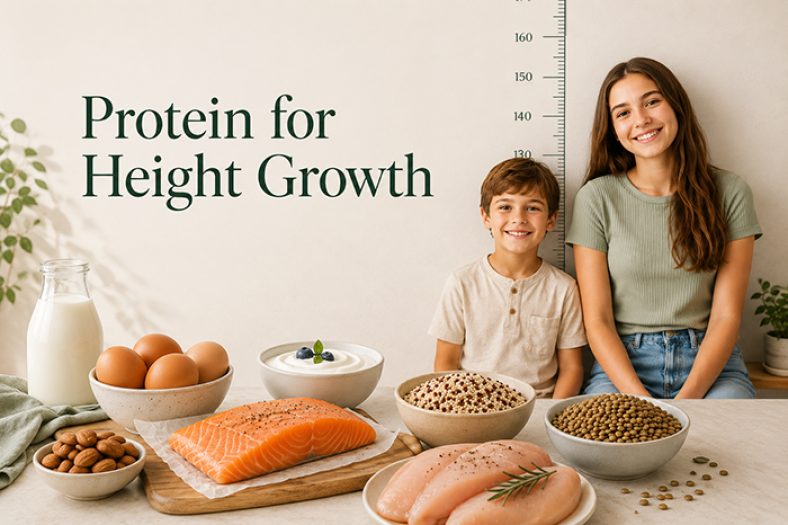
Protein is the most important single nutrient for height growth — it builds the bone tissue, powers the growth plates, and regulates the hormones that translate growth signals into actual centimeters. Here is a clear breakdown of how much kids and teens need at each age, and the best everyday sources to meet those targets.
Why Protein Is Central to Height Growth
Every centimeter of height gain involves the production of new tissue — bone matrix, cartilage, muscle, and connective tissue — and protein provides the amino acid building blocks for all of it. Growth is fundamentally a protein-intensive biological process, which is why protein deficiency is one of the most reliable predictors of growth faltering in children worldwide.
The type I collagen that makes up bone's protein scaffold is the same structural protein found in skin and connective tissue. Building it takes more than protein alone: vitamin C is required to complete collagen synthesis, which is also why it tops most lists of the best vitamins for skin.
The relationship between protein and height operates through several distinct mechanisms:
Protein also supports the absorption and metabolism of calcium. Studies in children show that higher protein intakes, within recommended ranges, are associated with greater calcium retention in bone — meaning protein and calcium work synergistically rather than in competition, despite earlier concerns about high-protein diets leaching calcium.
Important context: More protein does not mean more height. Protein supports growth up to the recommended level — excess intake beyond needs does not further accelerate growth and places unnecessary load on the kidneys. The goal is consistent adequacy, not excess.
How Much Protein Do Kids and Teens Need for Height Growth?
The recommended dietary allowances (RDAs) below are from the Institute of Medicine and reflect the amount needed to meet the needs of nearly all healthy children in each age group. These figures are minimums for adequacy, not performance targets.
This is the easiest target to hit — one egg plus a cup of milk at breakfast already covers roughly half. Growth rate is steady but moderate in this window.
~0.95 g/kg body weight per day
Growth accelerates heading into puberty. This period often coincides with the start of peak height velocity, making protein adequacy especially important.
~0.95 g/kg body weight per day
Peak height velocity typically occurs in this window. Boys gaining 9–10 cm per year and girls gaining 7–8 cm per year have substantially elevated protein needs.
Active teens: up to 1.2–1.4 g/kg/day
Active teens and athletes: The RDA figures above apply to sedentary or lightly active children. Teens involved in competitive sports, strength training, or endurance athletics during their growth years may need 1.2 to 1.4 g per kg of body weight per day — meaningfully higher than the baseline RDA. A 60 kg teen athlete may need up to 84 g of protein daily.
Best Protein Sources for Growing Kids
Not all protein is equal for growth. Complete proteins — those providing all nine essential amino acids — are the most efficient at supporting bone matrix formation and IGF-1 production. The sources below are ranked by their practical value for hitting daily targets in a child-friendly diet.
Eggs have the highest biological value (BV) of any whole food protein source — meaning a greater proportion of egg protein is absorbed and used for tissue synthesis compared to other foods. One large egg provides 6 g of complete protein plus leucine, the amino acid that most directly triggers muscle and bone protein synthesis.
A randomized controlled trial in Pediatrics found that children receiving one egg per day for six months showed significantly higher IGF-1 levels and were 47% less likely to be stunted than controls — the most direct evidence linking a single protein food to growth outcomes.
Chicken breast is the most protein-dense lean meat available. A 3 oz (85 g) cooked serving delivers 26 g of complete protein — more than half a teen boy's daily target in a single serving — with minimal fat and no carbohydrates displacing calories from other nutrients.
It is also a significant source of niacin, B6, and phosphorus, all of which support bone metabolism. Its mild flavor and versatility make it the most practical high-protein food for school-age children and teens.
Fatty fish deliver 22–25 g of high-quality protein per 3 oz serving, alongside vitamin D — an important pairing because vitamin D amplifies the calcium-retaining effects of dietary protein in growing bone. No other food category combines these two nutrients as efficiently.
Canned tuna (in water) is one of the most affordable high-protein options for families: a single can provides roughly 25 g of protein at low cost, making it practical for frequent use in school lunches or quick dinners.
Greek yogurt delivers 17–20 g of protein per cup — roughly double that of regular yogurt — along with calcium, phosphorus, and casein, a slow-digesting protein that provides a sustained supply of amino acids during the overnight sleep period when the majority of daily growth hormone is released.
A bedtime snack of Greek yogurt is one of the most nutritionally logical choices for a growing child: it simultaneously covers protein, calcium, and slow-release amino acids during the body's primary growth window.
A cup of cooked lentils provides 18 g of protein alongside 6.6 mg of iron and 2.5 mg of zinc — two micronutrients critical for growth that are frequently deficient in children's diets. Beans and lentils are particularly valuable for vegetarian families or as a lower-cost alternative to animal proteins.
Legume protein is not complete on its own (low in methionine), but pairing with a grain (rice, bread, corn) at the same meal provides all nine essential amino acids and raises the protein quality close to that of animal sources.
Quinoa is the only grain that provides a complete amino acid profile — all nine essential amino acids in a single plant food. A cup of cooked quinoa delivers 8 g of protein, making it a meaningful protein contributor as a side dish or base grain rather than a minor accompaniment.
For vegetarian children who do not eat legumes regularly, or for families reducing meat consumption, quinoa is the most protein-rich grain option by a significant margin over rice, oats, or pasta.
Protein Content: Quick-Reference Comparison
| Food | Serving | Protein | Complete? |
|---|---|---|---|
| Chicken breast (cooked) | 3 oz (85g) | 26 g | ✓ Yes |
| Canned tuna (in water) | 3 oz (85g) | 25 g | ✓ Yes |
| Salmon (cooked) | 3 oz (85g) | 22 g | ✓ Yes |
| Greek yogurt | 1 cup (245g) | 17–20 g | ✓ Yes |
| Lentils (cooked) | 1 cup (200g) | 18 g | ✗ Incomplete |
| Cottage cheese | ½ cup (113g) | 14 g | ✓ Yes |
| Egg (large) | 1 egg (50g) | 6 g | ✓ Yes |
| Cow's milk | 1 cup (240ml) | 8 g | ✓ Yes |
| Quinoa (cooked) | 1 cup (185g) | 8 g | ✓ Yes |
| Kidney beans (cooked) | 1 cup (177g) | 15 g | ✗ Incomplete |
| Peanut butter | 2 tbsp (32g) | 7 g | ✗ Incomplete |
| Tofu (firm) | 3 oz (85g) | 9 g | ✓ Yes |
How Protein Intake Compares to Other Growth Nutrients
Sample Daily Meal Plan That Hits Protein Targets
The following example shows how straightforwardly a growing teen can meet the 46–52 g daily protein target through ordinary meals — without protein powders or supplements.
| Meal | Food | Protein |
|---|---|---|
| Breakfast | 2 scrambled eggs + 1 cup milk | 20 g |
| Lunch | Chicken sandwich (3 oz chicken + whole grain bread) | 30 g |
| Snack | Greek yogurt (plain, ¾ cup) | 13 g |
| Dinner | ½ cup lentils with brown rice | 12 g |
| Daily Total | ~75 g |
Note on the example above: The total of ~75 g significantly exceeds the RDA minimum, which is appropriate — the RDA represents a floor, not an exact target. Well-nourished children eating varied diets typically land in the range of 1.0–1.5 g per kg of body weight, which is safe and beneficial for active growth.
Signs a Child May Not Be Getting Enough Protein
Protein and Sleep: The Growth Hormone Connection
Growth hormone is released in pulses during slow-wave sleep — primarily in the first cycle, roughly 60 to 90 minutes after sleep onset. This nightly pulse is what drives longitudinal bone growth in children and teens, and the amino acids available in the bloodstream at that time determine how effectively the growth hormone signal is translated into new tissue.
This is why the timing of protein intake matters, not just the total. A small protein-containing snack before bed — a glass of milk, a serving of Greek yogurt, or a few tablespoons of cottage cheese — provides a pool of amino acids, particularly casein (which digests slowly over 5–7 hours), that coincides with the overnight growth hormone release window.
This is not a dramatic effect, but it is a real and practical one that requires no supplementation or significant dietary change — just a protein-containing bedtime snack as a consistent habit.
Protein for Vegetarian and Vegan Children
Children on vegetarian or vegan diets can meet protein targets through careful food selection, but require more intentionality than omnivores. The key challenges are protein completeness, leucine density (which plant proteins are generally lower in), and the absence of casein for overnight amino acid supply.
The Bottom Line
Protein is not a supplement or a performance enhancer for growing children — it is a foundational dietary requirement. Meeting the age-appropriate RDA consistently, rotating between animal and plant protein sources, and including a protein-containing food at each meal is sufficient for most children to support healthy longitudinal growth.
The cases where parents need to think harder about protein are active teen athletes, strict vegans, and picky eaters who avoid entire food groups. For everyone else, a varied diet including eggs, dairy, chicken, fish, and legumes across the week reliably meets targets — and does so without protein powders, specialized products, or significant dietary complexity.
Frequently Asked Questions
Can too much protein make kids grow taller faster?
No. Once protein intake meets the recommended level, additional protein does not accelerate growth further. Excess protein beyond needs is broken down and excreted, not converted into additional height. Chronically very high protein intakes (well above 2 g/kg/day) in young children may place unnecessary strain on developing kidneys, though this is rarely a practical concern in normal family diets.
Do kids need protein shakes or supplements to grow taller?
No. The protein targets for children and teens are achievable through ordinary foods — eggs, dairy, chicken, fish, and legumes. Protein supplements are designed for adult athletes looking to exceed their usual dietary intake and are unnecessary for a child eating a varied diet. If a child genuinely cannot meet protein targets through food due to allergies or selective eating, a pediatric dietitian can recommend targeted solutions.
Is plant protein as effective as animal protein for height growth?
Plant protein can support healthy growth when combined properly, but it requires more planning than animal protein. Animal proteins are complete, higher in leucine, and more bioavailable. Plant proteins are often incomplete individually and lower in leucine — the amino acid most directly linked to protein synthesis. Pairing grains with legumes solves the completeness issue, and adequate total intake compensates for the lower bioavailability. Children on well-planned plant-based diets consistently achieve normal growth outcomes.
At what age is protein most critical for height growth?
Protein is important throughout childhood, but the two windows of greatest impact are early childhood (ages 2–5, when catch-up growth from early deficiency is most possible) and the pubescent growth spurt (roughly ages 10–14 for girls and 12–16 for boys), when height velocity is at its maximum. Nutritional adequacy during the pubescent growth spurt has the largest single effect on final adult height among the controllable factors.
How does protein intake interact with growth hormone?
Dietary protein — particularly foods high in arginine and leucine — stimulates the liver to produce IGF-1, which is the primary mediator of growth hormone's effect on bone. Higher protein intakes within the normal range are consistently associated with higher IGF-1 levels in children, which in turn correlates with greater height velocity during the growth years. This is the main hormonal mechanism linking protein intake directly to height outcomes.