Growth Science
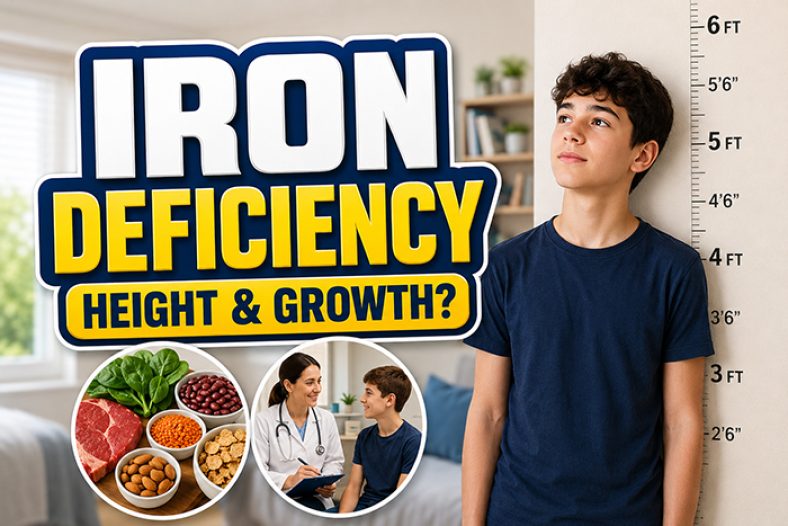
Our height-boosting foods guide already covers iron's RDA by age and the best food sources. This piece asks a more specific question: does low iron actually slow height growth, and does correcting it add height back? The honest answer turns out to be more mixed than the story for zinc, covered in a companion piece.
How Iron Actually Supports Bone Growth
Iron's best-known job is carrying oxygen in hemoglobin, but it has a second, quieter role in the skeleton. Iron is a required cofactor for prolyl and lysyl hydroxylase, the enzymes that chemically modify collagen so it can fold into its stable triple-helix structure. Since collagen makes up roughly 85 to 90% of bone's protein content, it's the scaffold that calcium and phosphorus mineral is deposited onto—without properly hydroxylated collagen, that scaffold is weaker, regardless of how much calcium is available.
A recent review of the iron-bone relationship lays this out directly: iron deficiency compromises collagen synthesis and also disrupts a related oxygen-sensing pathway involved in bone cell signaling, both of which can reduce bone mineral density independent of anemia itself.Iron deficiency compromises collagen synthesis, alters hypoxia-dependent signaling, and may affect vitamin D metabolism, collectively predisposing the individual to reduced bone mineral density and increased fracture risk This means iron's relevance to growth isn't purely about oxygen delivery to growing tissue—it's also a structural, molecular-level requirement for building the bone matrix itself.
Does Iron Supplementation Actually Make Kids Taller?
Given how directly iron is tied to collagen and bone, a clear height benefit from supplementation would be a reasonable expectation. The trial evidence doesn't fully back that up.
This is a genuinely different pattern from zinc. Zinc supplementation trials in deficient populations found a fairly consistent height benefit. Iron trials, even in similar populations, did not show the same clean result—and one systematic review specifically flagged a possible negative effect on linear growth with supplementation lasting six months or longer in developed-country settings. That's a real, published finding, not a reason for alarm, but it's a good example of why "this nutrient matters for growth" doesn't automatically mean "more of it adds height."
Why Doesn't Fixing Anemia Automatically Add Height?
Correcting iron-deficiency anemia reliably restores hemoglobin and oxygen-carrying capacity—that part of the evidence is solid. What it doesn't reliably do is add extra centimeters on top of that. One reasonable explanation: the collagen-hydroxylation role described above needs iron to be adequate, not abundant. Once a child's iron status crosses back into the normal range, the enzyme has what it needs, and additional iron on top of that doesn't necessarily build more collagen or accelerate the growth plate the way a genuinely deficiency-responsive nutrient like zinc appears to.
The Iron-Zinc Balancing Act
There's a second, practical reason to be cautious about simply adding more of everything: iron and zinc compete for the same absorption pathway in the gut. A randomized trial in Indonesian infants found that combining iron and zinc supplements reduced the biological benefit each one delivered on its own, compared with giving either mineral by itself.There was a significant dose effect on serum zinc in the Zn group, whereas no dose effect was [seen when iron and zinc were combined]
This is a real reason to avoid stacking supplements without a plan. A child taking a high-dose iron supplement and a separate zinc supplement at the same time may be getting less benefit from each than expected, not more. If both are genuinely needed, spacing doses apart in the day is a reasonable, low-effort way to reduce the competition—worth raising with a pediatrician rather than guessing.
Signs of Iron Deficiency in Kids
Who's Actually at Risk of Low Iron
| Group | Why the Risk Is Higher |
|---|---|
| Toddlers drinking a lot of cow's milk | Milk is low in iron, and a toddler filling up on it often eats less of the iron-rich solid foods that would otherwise cover the gap. |
| Teen girls with heavy periods | Regular menstrual blood loss is one of the most common causes of iron deficiency in adolescent girls specifically. |
| Vegetarian or vegan kids | Plant-based (non-heme) iron is absorbed less efficiently than the heme iron in meat, so overall intake needs to run higher to compensate. |
| Kids with GI conditions | Conditions like celiac disease can cause chronic, low-grade blood loss or malabsorption that quietly depletes iron stores over time. |
| Endurance athletes | Regular intense training can increase iron losses and turnover, raising requirements above what a typical diet was built around. |
What This Means in Practice
The practical takeaway: iron is genuinely important for growing bodies—both for oxygen delivery and for building the collagen scaffold bone is deposited onto—but the height-specific evidence for supplementation is much less consistent than it is for zinc. Iron-deficiency anemia is worth diagnosing and treating properly for its own sake; it's just not a reliable height lever on its own. For the RDA numbers and best food sources, see our height-boosting foods guide, and for the contrasting, more consistent nutrient story, see our zinc and height growth guide.
Frequently Asked Questions
Does iron deficiency stunt a child's height?
Iron plays a real structural role in building bone collagen, and severe or chronic deficiency is a plausible contributor to slowed growth. However, the clearest evidence for a height benefit from correcting it hasn't been consistently shown in supplementation trials, unlike the pattern seen with zinc.
If my child has iron-deficiency anemia, will treating it make them taller?
Treating anemia will reliably improve hemoglobin, energy, and oxygen delivery. Multiple large trials have not found that it reliably adds extra height on top of those benefits, so it's reasonable to treat anemia for its own clear benefits without expecting a height bonus.
Can my child take iron and zinc supplements together?
They can, but the two minerals compete for absorption in the gut, and combining high doses of both may reduce the benefit of each compared with taking them separately. If a child genuinely needs both, spacing the doses apart during the day is a reasonable way to reduce this competition.
What is pica, and why does it matter?
Pica is an unusual craving to eat non-food items like ice, dirt, or paper. It's a recognized, fairly distinctive sign of significant iron deficiency and is worth mentioning to a pediatrician if noticed, alongside more common signs like fatigue and pale skin.
My child's anemia isn't improving with iron supplements—what does that mean?
Anemia that resists typical iron dosing is a recognized red flag for an underlying absorption problem rather than just needing a higher dose. Conditions like celiac disease are a known cause of this specific pattern and are worth ruling out.