Growth Science
Our guide to exercise and height already covers why no sport raises a person's genetic ceiling, and our stretching guide touches briefly on the "swimmers are tall" selection bias. This piece goes much deeper on swimming specifically: the real spine physics behind why you measure taller right after a swim, the actual body-proportion research behind why elite swimmers look the way they do, and the real physical trade-off — shoulder, knee, and back overuse — that young swimmers and their parents should know about instead.
Where the "Swimming Makes You Taller" Belief Comes From
Competitive swimmers train through exactly the years — roughly 10 to 17 — when puberty's growth spurt happens anyway. The calendar gets credited to the pool.
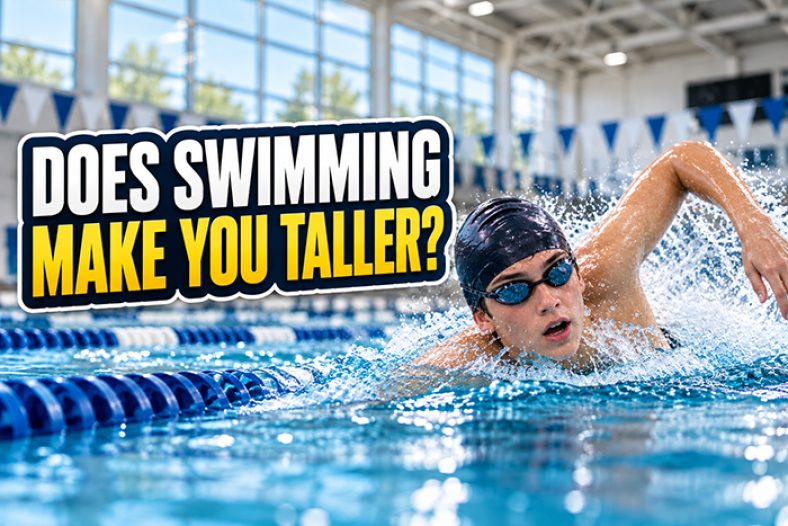
You genuinely do measure slightly taller right after a swim — that part is real. The leap to "permanently taller" is where the myth takes over.
What Actually Determines Height
"Everything else" = nutrition, sleep, overall health, and illness — not sport or exercise
Height itself is set by the biology covered elsewhere on this site: sex hormones drive the growth plates to lengthen bone during peak height velocity, then signal those plates to fuse permanently once puberty ends. Water resistance and kick power don't touch that hormonal process — a growth plate responds to growth hormone and IGF-1, not to laps swum.
The Real Physics: What Water Actually Does to the Spine
This part of the myth is actually grounded in something real. Here's the mechanism, step by step:
Discs compress all day, losing water — ~1.5-2.5 cm shorter by evening
Buoyancy takes weight off the spine's structures
Confirmed on MRI in spinal-unloading research
Normal gravity reloads the spine within hours
The honest caveat: that 1.5 cm figure comes from days of continuous, near-total unloading — not one swim practice, which involves active effort and only partial buoyancy support. A pool session almost certainly produces some version of this effect (consistent with people measuring taller right after swimming), but it hasn't been isolated and measured the way dry-immersion research has. The mechanism is real and well established; it's just temporary either way.
The Real Selection Story: Proportions, Not Just Height
Basketball selects for raw height. Swimming selects for something more specific: proportions. Peer-reviewed anthropometric research consistently finds elite swimmers have longer arm spans and different trunk lengths than the general population and than lower-level swimmers — because a longer span covers more distance per stroke, a genuine hydrodynamic edge independent of fitness or technique. One study found international-level swimmers significantly exceed national-level swimmers in height, span, and vertical reach — not just the general population, meaning each competitive tier re-filters for the same traits.
| Group | Arm Span vs. Height | What the Research Found | What Explains It |
|---|---|---|---|
| General Population | Roughly equal (ratio ≈ 1.0) | The Vitruvian baseline — arm span and height track closely for most people. | The reference point most anthropometric studies compare athletes against. |
| National-Level Swimmers | Modestly above average | Anthropometric studies find span, vertical reach, and hand size already elevated versus non-swimmers. | An early filter — swimmers who advance past entry level already skew toward these proportions. |
| International-Level Swimmers | Clearly above national-level peers | Comparative anthropometric research found international swimmers significantly exceed national-level swimmers in height, span, and vertical reach — not just the general population. | Each competitive tier re-filters for the same proportions, compounding the gap. |
| Youth Talent-ID Selection | Favors early maturers | Research on youth swimming selection finds a documented relative age effect tied to biological maturity status, separate from anthropometry alone. | Selection starts young, filtering on maturity timing as much as body size. |
Youth swimming shows this compounding clearly. Research on relative age effects in youth swimming — the well-documented tendency for athletes born earlier in a selection year to be overrepresented — found this pattern is tied to biological maturity status, meaning kids who are further along in puberty at the same chronological age carry a real, if temporary, advantage in selection and advancement. That's a maturity-timing effect layered on top of the proportion effect, not a separate story: both filter for who gets picked, kept, and advanced, long before any training effect could plausibly explain the gap.
Selection compounds at every level, same as in other sports. A kid with a favorable proportion profile is more likely to be identified early, more likely to get coaching attention and advanced technique work once identified, more likely to be moved onto elite training squads, and so on. By the time you're looking at an Olympic starting block, you're looking at the tail end of a filter that's been running since age-group swim meets — not a group of swimmers whose proportions were built by the sport itself.
What Swimming Does Do for a Growing Body
The Real Physical Risk: Overuse Injuries in Young Swimmers
The genuine physical story with swimming and growing bodies isn't about height — it's about how much repetitive, high-volume motion the sport demands from the shoulder, knee, and lower back, often during exactly the years those structures are still developing. Competitive swimmers routinely perform thousands of shoulder revolutions per session, and research consistently identifies three specific overuse patterns tied to that volume.
What This Means For You
The practical takeaway: swimming doesn't make anyone taller — height is roughly 80% genetic, and the temporary height bump people notice after a swim reflects real spinal-unloading physics, not permanent growth. The sport's tall, long-limbed elite competitors reflect who gets selected and advanced through anthropometry and maturity-based talent identification, not what swimming does to a person's skeleton. What swimming genuinely offers a growing body is excellent low-impact cardiovascular fitness, paired with a real, documented overuse injury pattern — shoulder, knee, and lower back — tied to training volume. For the full comparison of how swimming stacks up against other sports on bone density specifically, see our guide to the best sports for bone growth, and for how this same selection-not-causation pattern plays out in another sport entirely, see our piece on whether basketball makes you taller.
Frequently Asked Questions
Does swimming make you taller?
No. Height is roughly 80% determined by genetics, and no amount of swimming changes when or how much the growth plates lengthen bone. The temporary height increase people notice after a swim comes from real spinal-unloading physics — it isn't permanent growth.
Why do I measure taller right after swimming?
Buoyancy reduces the gravitational load your spine normally carries, which allows compressed intervertebral discs to rehydrate and swell slightly — the same mechanism behind why people measure taller in the morning than at night. Research on prolonged water and microgravity-like unloading confirms this mechanism directly, though the specific numbers come from days of continuous unloading, not a single practice. Either way, the effect reverses once normal gravity reloads the spine.
Why are elite swimmers so tall and long-limbed, then?
Because a longer arm span covers more distance per stroke, which is a genuine mechanical advantage in the water, coaches and talent-identification programs favor swimmers with these proportions at every competitive level. Anthropometric research consistently finds elite swimmers have longer arm spans and different trunk proportions than the general population — a selection pattern, not something training builds.
Is swimming bad for a growing child's bones or joints?
Swimming isn't harmful to bones, but as a non-impact sport it doesn't build bone mineral density the way jumping or cutting sports do. It's also linked to well-documented overuse injuries during heavy training — particularly swimmer's shoulder, breaststroker's knee, and low back pain tied to butterfly and breaststroke. These are manageable with attention to training volume and early symptom reporting.
Should a shorter child avoid competitive swimming since it won't make them taller?
No — proportion is only one factor in swimming success, and technique, training, and stroke efficiency matter enormously alongside it. There's no reason to steer a child away from a sport they enjoy just because it won't change their genetic height ceiling; almost no sport does.